
Early Retirees Volunteering Opportunities may not be the first thing that comes to mind when you think about retirement. After all, isn’t retirement supposed to be about finally doing whatever you want?
Absolutely.
But that’s precisely why volunteering can be worth considering.
Once the alarm clock and daily commute disappear, you suddenly have something many working people never seem to have enough of: time. You can spend some of it traveling, pursuing hobbies, visiting family or simply doing nothing at all. But you may also discover that you miss having somewhere to go, people to see and a reason to get out of the house.
That doesn’t mean you need another job.
Volunteering can be something much more flexible.
And the good news is that you don’t have to know exactly what you want to do before you start looking.
I certainly don’t claim to be an expert on volunteering. But I was curious about what is actually available to today’s early retirees, so I started looking at what established organizations are offering. What I found was considerably broader than I expected.
You Don’t Have to Volunteer 40 Hours a Week
Perhaps the first misconception worth clearing up is that volunteering requires a major commitment.
It doesn’t.
AmeriCorps Seniors’ RSVP program, for example, is specifically designed for people age 55 and older. Volunteers can choose how, where and when they serve, with commitments ranging from only a few hours to as much as 40 hours per week. Current opportunities include tutoring, tax preparation, disaster assistance, food programs, mentoring and workforce-development activities.
That flexibility could be particularly attractive to an early retiree.
Maybe you’re not ready to fill your calendar. Perhaps you want to volunteer Tuesday mornings and keep the rest of the week for yourself.
That’s perfectly reasonable.
Harvard Health makes a similar point. In discussing work and volunteering during retirement, Harvard Health notes that volunteering can provide “social interactions, physical movement, mental stimulus” and, importantly, a sense of purpose.
That sounds less like giving up your freedom and more like finding a worthwhile way to use some of it.
Start With What You Already Know
You don’t necessarily need to reinvent yourself when you retire.
In fact, your previous career may give you some of the most useful volunteering skills available.
Were you an accountant? AARP Foundation Tax-Aide uses trained volunteers to help people with their tax returns. The program says no previous tax-preparation experience is required because training is provided. Volunteers generally serve one to three days a week during tax season.
Were you a teacher?
AARP Foundation Experience Corps connects older volunteers with elementary-school students who need help developing reading skills. One Experience Corps volunteer, Bill Wolff, described the experience this way:
“Retirement gives you a chance to do things you want to do, rather than those you have to do.”
Perhaps you worked in business, technology, marketing, construction or administration.
Those skills don’t suddenly become worthless because you’ve retired.
And here’s something else to consider: you don’t have to volunteer in the same field in which you worked.
A retired accountant might enjoy working in a community garden. A former executive might prefer delivering meals. A retired teacher might discover that helping at an animal shelter is more satisfying than returning to a classroom.
The point is to explore.
Five Places to Look for Early-Retirement Volunteer Opportunities
You could start by typing “volunteer opportunities near me” into a search engine, but there are more reliable ways to begin.
1. AARP Create the Good
AARP Create the Good is an excellent starting point for people over 50.
Its searchable database allows you to look for opportunities by location, interests and category. Importantly for retirees who aren’t ready for a regular schedule, it also has a filter for home and remote opportunities.
AARP also offers its own volunteer programs, including Tax-Aide, Driver Safety, Experience Corps and opportunities involving health and wellness.
That’s a pretty broad menu.
2. AmeriCorps Seniors RSVP
AmeriCorps Seniors RSVP is another excellent place to investigate.
It isn’t a single type of volunteer job. It is a national network connecting people 55+ with local organizations.
You might tutor children, help prepare taxes, assist with disaster recovery, support food programs, mentor people looking for work or help older adults remain independent.
The program currently has more than 143,000 participants, according to AmeriCorps, and its Pathfinder tool allows prospective volunteers to search for current opportunities.
3. Meals on Wheels
If you enjoy getting out and meeting people, Meals on Wheels America offers another straightforward option.
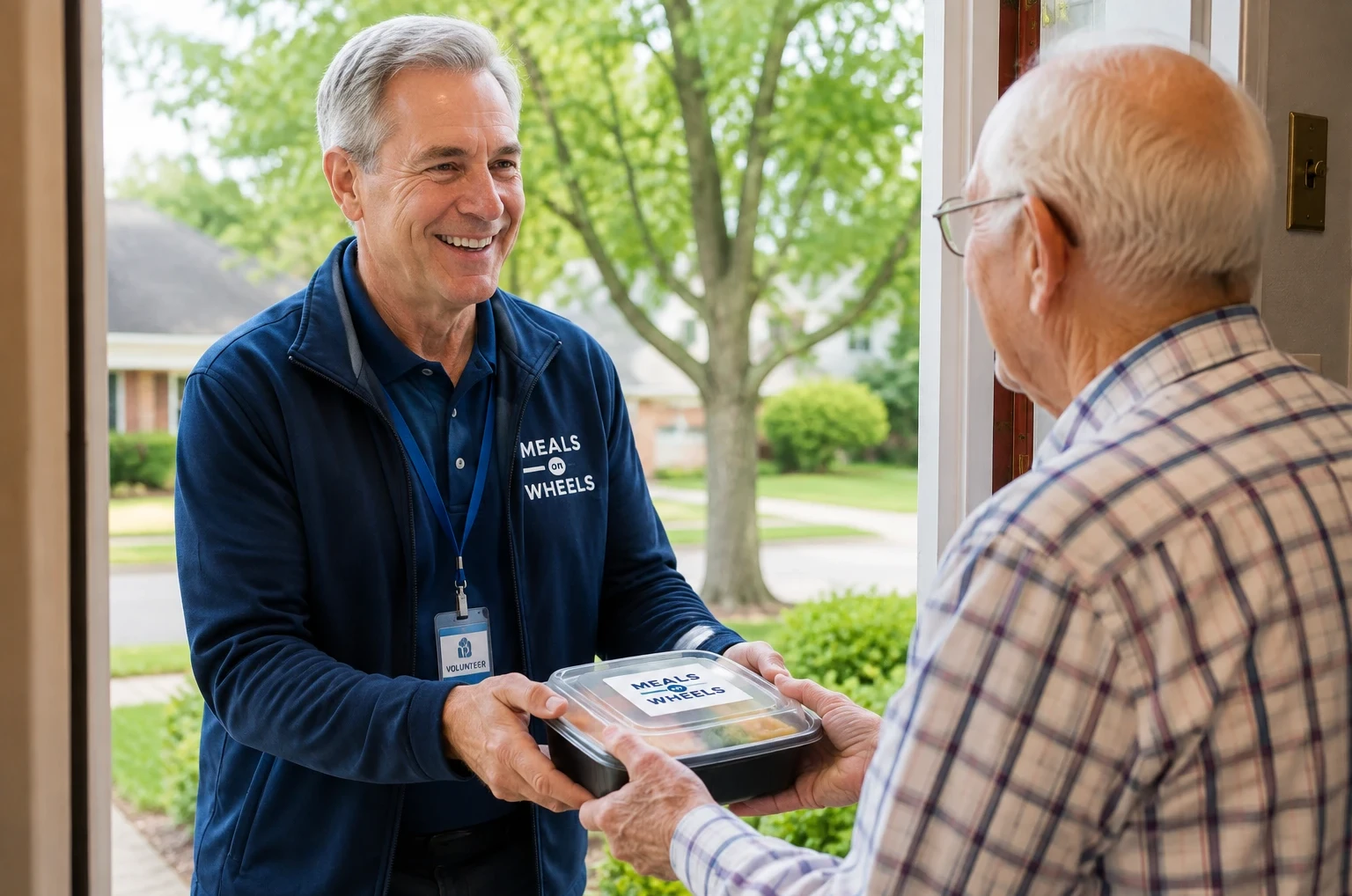
The most familiar role involves delivering meals to older adults who are homebound. But that’s not the only job. Local programs also need help with meal preparation, administrative work, fundraising, special events and client check-ins.
And the time commitment can be surprisingly manageable. Meals on Wheels says many volunteer assignments fit within roughly an hour and a half, although schedules vary by local provider.
The organization recently profiled one volunteer’s experience, noting that volunteers don’t simply deliver meals—they also provide “moments of connection” to people who might otherwise be isolated.
4. National Parks and Local Conservation
If sitting behind a desk isn’t what you had in mind for retirement, look at the National Park Service’s Volunteers-In-Parks program.
Opportunities vary enormously from park to park. They can include visitor services, interpretation, trails, conservation projects and special events. Some assignments are short-term, while others require a longer commitment.
This could be particularly appealing to an active retiree who likes the outdoors.
You aren’t simply helping an organization.
You’re getting outside, meeting people and spending time somewhere interesting.
5. Museums, History and the Arts

Here’s one I found particularly interesting.
The Smithsonian currently has more than 6,000 volunteers working onsite and another 7,500 participating in online projects. Opportunities include visitor information, tours, education, research, collections, administration, citizen science and digital projects.
You don’t have to be a museum expert to investigate the possibilities.
Some positions involve welcoming visitors or helping them find their way around. Others are behind the scenes.
If history, science, art or education interests you, this is the kind of volunteering opportunity that can actually feed your curiosity while you’re helping someone else.
What Does Volunteering Do for the Volunteer?
Here’s where I think we need to be careful.
You’ll often read that volunteering will make you healthier, happier, smarter and perhaps even live longer.
The evidence is encouraging—but it’s not quite that simple.
A large Harvard-affiliated study published in the American Journal of Preventive Medicine followed 12,998 adults over age 50. Those who volunteered at least 100 hours per year—roughly two hours a week—had lower risks of mortality and physical-function limitations and reported more physical activity, optimism and purpose in life. They also reported less loneliness and greater contact with friends.
But the researchers did not find that volunteering improved every health outcome they examined. There was no association with conditions including diabetes, hypertension, stroke, cancer, heart disease, arthritis or cognitive impairment.
That’s an important distinction.
Volunteering isn’t a medical treatment.
It is simply one activity that may contribute to a more active, connected and purposeful life.
A 2022 randomized controlled trial involving 445 fully retired adults aged 60 and older found that participants who began formal volunteering showed improvements in life satisfaction, purpose in life and personal growth compared with the control group.
And the American Psychological Association reported in 2026 that research links volunteering and other acts of kindness with greater happiness and lower depression and loneliness, with social connection appearing to be an important part of the explanation.
That’s considerably more convincing to me than simply saying, “Volunteering is good for you.”
What If You Don’t Know What You Want to Do?
That’s probably the easiest problem to solve.
Don’t commit immediately.
Try something.
Volunteer for a one-day event. Help at a food distribution. Attend an orientation. Spend a few hours at a museum. See what happens.
You may love it.
You may discover that it’s not for you.
Both results are useful.
Pay attention to how you feel afterward. Did you enjoy talking with people? Would you rather work behind the scenes? Did you like being outdoors? Was the physical effort too much—or not enough?
Those answers will tell you considerably more than sitting at home trying to imagine your perfect volunteer position.
And don’t overlook virtual volunteering. AARP’s Create the Good platform specifically includes opportunities that can be performed from home.
That can be useful if transportation, mobility, weather or simply convenience makes regular travel difficult.
Keep Volunteering in Its Proper Place
One of the best things about retirement is that your time belongs to you.
Volunteering shouldn’t become another boss.
Start with a manageable commitment—perhaps two or three hours a week—and see how it fits.
If you find something you really enjoy, you can always do more.
And if you discover that a particular organization isn’t a good fit, move on.
AARP recently profiled Muriel Craig, a retiree who tried several activities after retirement before finding something she wanted to do consistently. Her experience eventually led her into AARP volunteering. The lesson isn’t that everyone should volunteer; it’s that sometimes you have to try a few things before discovering what fits.
Your Retirement, Your Choice
I started researching Early Retirees Volunteering Opportunities with the assumption that I would find a fairly predictable list of charitable activities.
Instead, I found tutoring, tax preparation, museums, national parks, meal delivery, disaster response, technology, mentoring, community improvement and opportunities that can even be performed from home.
That’s quite a range.
And perhaps the most important thing I’ve learned is that volunteering doesn’t have to be some grand declaration that you’re going to spend the rest of retirement helping mankind.
It can be much simpler.
You might have three spare hours on Tuesday morning.
You might enjoy working with children.
You might love animals.
You might miss using the skills you developed during your career.
Or perhaps you simply want a reason to get out of the house and meet some new people.
Start there.
Look around. Ask questions. Try something.
As Harvard Health put it in discussing volunteering and retirement, the important thing is to find a fit that aligns with your “goals, time commitment, personal interests, and comfort level.”
That sounds like pretty good advice to me.
And if this article inspires you to share your own experiences, start a blog, or build a website about volunteering or perhaps a hobby, a resource like Wealthy Affiliate can be worth mentioning because it provides training, tools, and community support for people who want to learn how to create and grow an online presence.
Retirement gives you the freedom to choose what comes next. Volunteering is simply one of the many possibilities worth exploring.